The Biggest Differentiator Between Relational and Columnar Databases
How storage layout, ACID properties, the CAP theorem, and scaling shape the choice between relational and columnar databases.
The biggest differentiator between a traditional relational database and a columnar analytical database is how data is physically organized and how it is expected to be read.
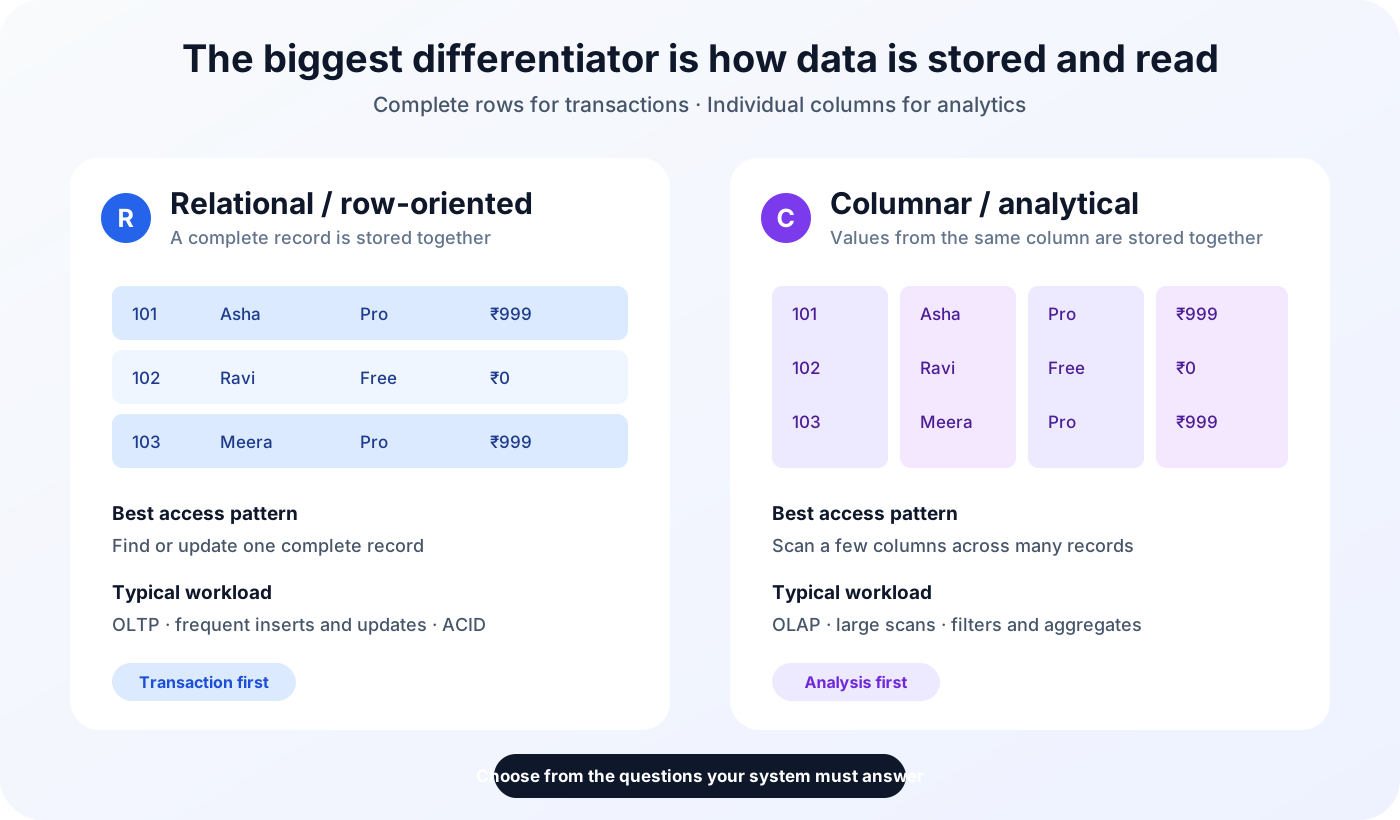
A row-oriented relational database stores the values of one record together. A columnar database stores values from the same column together. This difference sounds small, but it changes which queries are efficient, how well data compresses, and how the database scales.
Key Terms to Talk About
Row-oriented storage · Column-oriented storage · OLTP · OLAP · ACID · CAP theorem · Compression · Vertical scaling · Horizontal scaling · Distributed queries
Begin with the questions
Consider a subscription system containing this data:
user_id | name  | plan | monthly_price
101     | Asha  | Pro  | 999
102     | Ravi  | Free | 0
103     | Meera | Pro  | 999
The application may ask:
Find user 101.
Change user 102 from Free to Pro.
Create a subscription and payment together.
These operations access or update complete records. A row-oriented relational database is a natural fit because all the values for one user are stored together.
An analytics system asks different questions:
What is the average monthly price?
How many users have each plan?
What was total revenue by region for the last year?
These queries may scan millions of records while reading only two or three columns. A columnar database can read the required columns without loading every name, identifier, and unused field.
Row storage versus column storage
Imagine that the table is written to disk in row order:
[101, Asha, Pro, 999]
[102, Ravi, Free, 0]
[103, Meera, Pro, 999]
Finding user 102 retrieves the complete record efficiently. Updating that user’s plan also affects a localized row.
Columnar storage organizes the same data differently:
user_id:       [101, 102, 103]
name:          [Asha, Ravi, Meera]
plan:          [Pro, Free, Pro]
monthly_price: [999, 0, 999]
To calculate the average price, the database reads only monthly_price. Values within a column also tend to be similar, so they compress extremely well. Less data must be read from storage and moved through memory.
This gives us the central distinction:
Row-oriented:    a few complete records
Column-oriented: a few columns across many records
ACID properties
ACID describes four guarantees commonly associated with transactions:
- Atomicity: all operations in a transaction succeed or all are rolled back.
- Consistency: a transaction moves the database from one valid state to another.
- Isolation: concurrent transactions do not produce invalid interference.
- Durability: committed changes survive failures.
Suppose a customer purchases a subscription. The system may need to create a payment, activate the plan, and record an invoice as one transaction. A partial result would be dangerous. Traditional relational databases are designed to make this kind of multi-record transaction dependable.
Columnar databases can also support transactions, and some provide strong ACID guarantees. The practical difference is emphasis: analytical column stores are generally optimized for bulk ingestion and large reads rather than frequent, small, multi-row updates.
ACID is therefore not a strict dividing line between relational and columnar databases. It is a requirement to evaluate. If the system depends on frequent transactional updates, examine the database’s transaction model carefully.
The CAP theorem
The CAP theorem applies to a distributed system when a network partition occurs. During that partition, the system must choose between:
- Consistency: every read receives the latest successful write or an error; and
- Availability: every request receives a non-error response, although it may not contain the latest write.
Partition tolerance is not usually optional for a distributed database because network failures can happen.
CAP does not mean that every relational database is consistent and every columnar database is available. A single-node relational database is not making a distributed CAP trade-off at all. Distributed relational and distributed columnar systems can make different choices depending on their architecture and configuration.
For a payment transaction, serving stale data may be unacceptable, so the design may favor consistency during a partition. For an analytical dashboard, temporarily showing slightly old aggregates may be acceptable, so the system may prioritize availability.
The correct CAP decision comes from the product requirement, not the storage format.
Vertical scaling
Vertical scaling means giving one database server more resources:
More CPU
More memory
Faster and larger storage
Traditional relational systems often begin this way because it keeps transactions and operations simple. A stronger machine can handle more connections and a larger working set without distributing data across multiple nodes.
Vertical scaling has a limit. The largest machines are expensive, and a single machine has finite CPU, memory, storage, and I/O bandwidth. It can also remain a failure boundary unless replicas provide redundancy.
Horizontal scaling
Horizontal scaling means spreading data and work across more machines:
Node 1 + Node 2 + Node 3 + ...Large analytical workloads benefit from this model. A query can be divided across nodes, with each node scanning its local columns and returning a partial aggregate. A coordinator then combines the results.
For example, to calculate annual revenue, twelve nodes might each process one month of data. The final answer is the sum of their partial results.
Horizontal scaling is not free. The system must decide how to partition data, replicate it, recover failed nodes, and coordinate distributed queries. Cross-node joins and transactions are more complicated than operations contained on one machine.
Modern relational databases can scale horizontally, and columnar databases can run on a single node. The distinction is again about typical design priorities rather than an absolute rule. Distributed columnar systems are commonly built for parallel scans, while traditional relational systems often prioritize transactional simplicity before introducing sharding.
Comparing the common priorities
| Question | Row-oriented relational database | Columnar analytical database |
|---|---|---|
| Primary access pattern | A few complete records | A few columns across many records |
| Typical workload | OLTP transactions | OLAP analytics |
| Inserts and updates | Frequent, small operations | Often buffered or batched |
| Aggregations | Possible, but expensive at large scale | Core strength |
| Compression | Moderate | Often excellent |
| ACID transactions | Usually a primary strength | Support varies; often not the main workload |
| Initial scaling approach | Commonly vertical, then replicas or sharding | Commonly horizontal for parallel processing |
| CAP choice | Depends on the distributed architecture | Depends on the distributed architecture |
Relational and columnar are not opposites
There is an important nuance in the terminology. Relational describes a logical data model based on tables and relationships. Columnar describes a physical storage layout.
A database can be both relational and columnar. Some analytical warehouses expose tables, schemas, SQL, joins, and relational operations while storing data by column. Likewise, some relational systems offer columnar indexes or extensions alongside their row storage.
The real comparison is usually:
Row-oriented OLTP database
versus
Column-oriented OLAP database
Work backward from the output
Choose a row-oriented relational database when the system needs to find and modify individual entities, preserve relationships, and execute dependable transactions.
Choose a columnar database when the system needs to scan large datasets, read a subset of columns, calculate aggregates, and distribute analytical work across machines.
ACID, CAP, vertical scaling, and horizontal scaling matter, but none of them independently determines the database choice. Begin with the questions the application must answer, identify its read and write patterns, and then choose the storage and consistency model that produces those answers efficiently.